Profile or Interview: Two Ways to Meet a Performer
Profile or interview? Learn what each format can tell you about a performer’s words, work and public image, and choose the right source for your question.
The common mistake when choosing a profile or interview is treating them as interchangeable portraits of a performer. A profile or interview offers different evidence: one foregrounds a published exchange, while the other builds a narrative from selected material. Confusing them can leave you with an answer to a question you never asked.
Choose the format that matches the evidence you need. Read an interview for a response to a particular prompt; read a profile to see how a writer connects a performer’s work, remarks and public presentation.
An interview gives you a published exchange
An interview is the better starting point when you want to know what a performer says in response to a particular question. Read the prompt alongside the answer: a reply can sound more definite or personal when it is separated from what prompted it.
Check how the conversation is presented. A transcript may preserve turns in sequence; a polished question-and-answer feature may shorten replies, remove pauses or arrange topics for readability. The result records the conversation as published, but it is not necessarily a word-for-word account of everything said.
Notice whether the performer answers the question or redirects it. A response about preparing for a role, for instance, may describe rehearsal habits without explaining the larger artistic choice behind them. Keep the quotation within the limits of what the exchange supports.
A profile connects words, work and public image
A profile is more useful when you want to understand how a performer’s work, public remarks and reputation are presented together. The writer selects scenes, background, quotations and observations, then connects them into an account with a particular emphasis.
That structure can show how a new project fits into a career, how a performer speaks about a recurring theme, or how a writer frames a change in public identity. It can also make the writer’s interpretation feel like settled fact. Separate what the performer says from what the article infers or describes.
Pay attention to attribution. Direct quotations belong to the performer as published; scene-setting and transitions belong to the writer; claims about other people or events may come from sources named in the piece. A profile is not a neutral container for an interview: its order and emphasis shape the impression it leaves.
Match the format to the question you have
Before reading, put your question into plain words. If you want to know what the performer thinks about a particular decision, an interview may take you to the relevant exchange quickly. If you want to see how that decision sits alongside their work and public presentation, a profile may provide the broader frame.
- Check whether the interview includes the full question; if it does, read it with the answer, but if it does not, avoid treating a short reply as self-explanatory.
- Check whether a profile identifies the sources for its background; if it does, distinguish their claims from the writer’s framing, but if it does not, treat unsupported context cautiously.
- Check whether a claim about an event is an attributable statement; if it is, note who said it, but if it is the writer’s interpretation, do not repeat it as a confirmed fact.
- Check whether a quotation is presented in its original exchange; if it is, retain the question and surrounding context, but if it is detached, find the source before using it to describe a wider view.
- Check which details a profile foregrounds and which voices are absent; if the selection is narrow, describe the impression as the article’s framing, but if relevant perspectives are included, weigh them alongside the writer’s account.
- Check whether the piece explains its publicity context; if it is tied to a film or performance release, keep that assignment in mind, but if no context is given, avoid guessing why a topic was included.
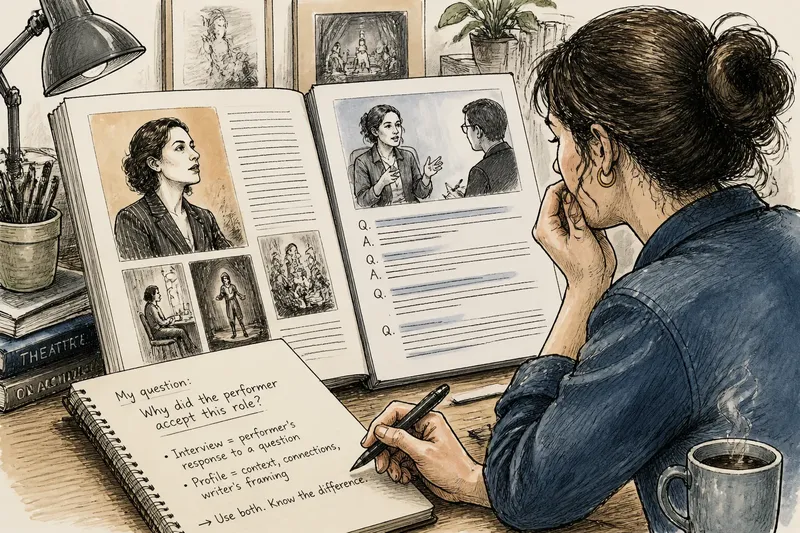
Say you want to know why a performer accepted a stage role. You start with an interview whose question asks directly about the choice, read the answer with its prompt, then compare a profile that places the answer beside career context and the writer’s account of the production. The interview supplies the performer’s stated reason; the profile supplies framing. Neither, by itself, establishes private motives.
Read editing and framing as part of the evidence
Neither format gives unfiltered access to a person. Interviews are shaped by the questions asked, the setting, the published selection and any editing. Profiles add a writer’s structure, description and point of view. These are features to account for when judging what a piece can support.
Notice how each article handles uncertainty. A careful interviewer may ask a follow-up when an answer is broad; a careful profile may distinguish an observed detail from an interpretation. If the article leaves a point unresolved, do not fill the gap with a confident guess about the performer’s character or intentions.
Publicity context can explain why certain subjects appear, but it does not settle whether a statement is sincere or complete. A conversation tied to a film or performance release may concentrate on that work; a profile may range further while still reflecting the assignment.
What can a profile or interview answer?
Does an interview show exactly what the performer said?
It shows the exchange as the publication chose to present it, not necessarily every word or pause from the conversation. Read the question and any editorial note before treating a short answer as complete.
Is a profile less reliable because a journalist wrote it?
No; the format simply includes more visible interpretation and arrangement. Assess whether the piece distinguishes reported information, direct quotations and the writer’s descriptions.
Which format is better for understanding a performer’s personality?
Neither can establish a private personality from public material alone. An interview records responses in a particular setting, while a profile creates an account from selected material; use both to understand presentation, not to claim certainty about private life.
Can a profile contain an interview?
Yes. A profile may include question-and-answer passages or quotations gathered in conversation, while its overall structure remains a narrative shaped by the writer.
Keep the distinction when you compare pieces
Make a note of the question you are trying to answer, the passage that addresses it and whether that passage is a quotation, reported context or interpretation. This keeps a vivid scene in a profile from being mistaken for a direct statement, and an interview answer from being stretched into a complete account.
For a direct explanation, choose the interview; for a connected account of work and public presentation, choose the profile. If your question asks for both, read each on its own terms and keep the performer’s published words distinct from the writer’s narrative. For a profile or interview, that distinction helps you describe not only what a piece says, but also how it shapes the performer’s public image.