A Small Archive for Press Images and Profiles
Organise a small archive for press images and profiles by format and source, making items easier to find while keeping uncertain origins and gaps visible.
The common mistake in a small archive for press images and profiles is to file every item under a performer’s name and leave it there. Later, a portrait, a profile and a press-sheet scan can blur together, and the source of each item may disappear. Record both what each item is and where it came from.
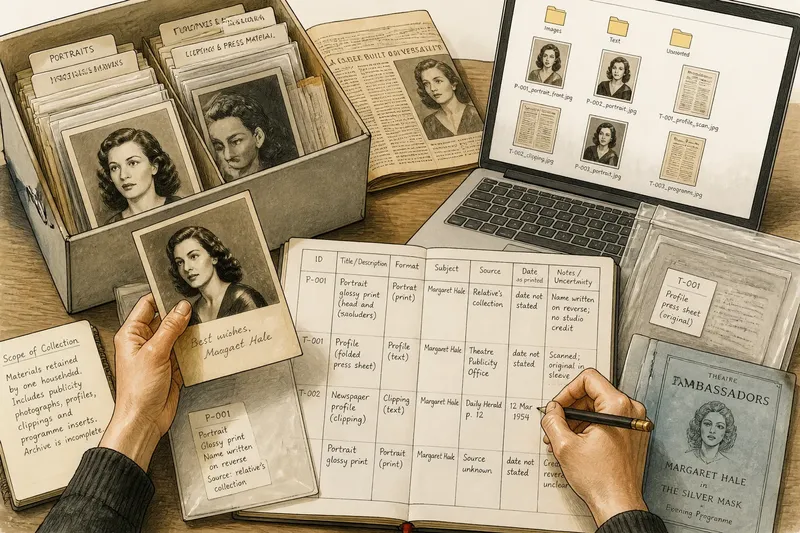
Imagine you inherit a shoebox of publicity material about a theatre performer: glossy portraits, a folded profile, a newspaper clipping and digital scans with uneven filenames. You want to make the collection searchable without implying it represents every image or article ever issued. Give each item a stable place, a useful description and an honest account of what is known.
Start with the collection you actually have
Before choosing folders or labels, make a rough inventory of the material in front of you. Separate physical items from digital files, and note broad formats such as portrait, profile, interview, press release, clipping or programme insert. Treat these as working categories, not definitive descriptions.
Use a spreadsheet or simple database. Useful columns include an item ID, short title or description, format, named subject, source, date as printed, physical or digital location, and a note about uncertainty. Leave a field blank when you do not know the answer; do not fill gaps with guesses to make the table look complete.
For the imagined shoebox, assign IDs such as P-001 for a portrait and T-001 for a text item. These labels distinguish objects without implying importance or chronology. Use the same IDs on archival sleeves, in filenames and in the inventory as the collection grows.
Separate format from source
Format answers, “What kind of item is this?” Source answers, “Where did this particular copy come from?” Keep those questions in separate fields. A portrait may have come from a press office, a magazine or an unattributed web page; those are different histories even if the image looks identical.
Use broad, consistent format terms rather than creating a new category for every variation. Label a publicity photograph as a portrait, then record whether it is a print, scan or digital file in a separate medium field. Describe a newspaper profile as a clipping, and enter the publication or page details in the source fields when they are present.
In the imagined collection, group the glossy portraits with other physical images, but retain each item’s known source in its record. Keep the clipping and folded profile among text items, even if a portrait appears alongside one. If two copies seem to show the same image, record them as separate objects until you have a reason to treat them as duplicates.
Record evidence without filling in the blanks
Transcribe visible information as it appears: a caption, credit line, publication name, printed date or stamp on the back. Distinguish that evidence from your own description. If lettering is hard to read, write “photographer credited on reverse; name unclear” rather than treating the credit as certain.
When a date is absent, write “date not stated”. If a date is legible but its meaning is unclear, transcribe it and add a note that it could refer to publication, printing or distribution. Do not assign a precise date based only on a performer’s appearance, hairstyle or presumed career period.
In the imagined archive, one portrait has a handwritten name but no studio or publication credit. Its record can say “name written on reverse; writer unknown” and identify the physical source as the relative’s collection. This preserves what can be observed while leaving the item’s earlier route open to question.
Give physical and digital items a stable home
Store photographs in suitable archival sleeves and keep paper clippings apart from materials that could transfer ink or create folds. Use a pencil on an appropriate sleeve or enclosure rather than marking an image. For fragile or valuable objects, ask a qualified archivist or conservator for handling and storage advice, and follow relevant supplier guidance.
For digital copies, use filenames that connect each file to its inventory record, such as “P-001_portrait_front” or “T-001_profile_scan”. Keep the original filename in the record if it carries useful clues, and do not overwrite an original scan when making a cropped or colour-adjusted copy. A simple folder structure might divide “Images”, “Text” and “Unsorted”, with the inventory as a cross-reference.
In the imagined collection, the owner scans the folded profile and saves it under its ID, then keeps the physical item in a sleeve marked with the same ID. The record links the scan and original without claiming that the scan replaces the original or captures every detail.
What questions come up when organising a small archive for press images and profiles?
Should items be arranged by performer or format?
Use the inventory to search by performer, and use physical or digital folders to group items by format. A portrait can stay with other images while remaining searchable under the named subject.
What should you do when the source is unknown?
Write “source unknown” and record where you received the item, if known. Put visible marks or captions in a separate note so a future reader can assess them without mistaking an inference for a fact.
Should you keep duplicate publicity photographs?
Keep copies that differ in condition, markings, cropping or provenance, and record the distinction. If two items appear identical, note that observation before discarding either; the reverse or file metadata may contain useful information.
How can you show that the archive is incomplete?
Describe its scope plainly, such as “materials retained by one household” or “items gathered from a theatre programme and personal papers”. Note known gaps without implying that missing material never existed.
Check each record before filing an item
Before putting an item away, compare it with its inventory entry. Use the result of each check to decide whether the record is ready or needs a correction:
- Check that the item has a unique ID; if it does, use it on the record and enclosure, but if it does not, assign an unused ID before filing.
- Check whether the format is identifiable from the item; if it is, enter a broad format such as portrait or clipping, but if it is not, use “format unclear” and add a note.
- Check for a printed or handwritten source clue; if one is legible, transcribe it, but if none is present or it cannot be read, record “source unknown” or “source partly illegible”.
- Check whether a date is printed or stamped; if its meaning is clear, record it as printed, but if it is absent or ambiguous, write “date not stated” or note the ambiguity.
- Check whether the item is physical, digital or represented in both forms; if both forms exist, link them by ID, but if only one exists, record that location without implying a missing copy.
- Check whether a similar item is already listed; if differences in condition, markings or source are visible, keep separate records, but if no difference is apparent, note the possible duplicate and compare before removing either.
Let the archive show its limits
After sorting the imagined collection, the owner has an inventory, IDs linking records to objects, and separate groupings for images and text. The portrait with an uncertain handwritten name remains discoverable, but its origin is not upgraded into a fact. A reader can find the item and judge the record for themselves.
Write a brief scope note at the top of the spreadsheet or inside the first folder. Say who assembled the material, if known, what kinds of items are included, and whether the collection is a partial personal holding. When someone adds an item, record who supplied it and when it entered the archive; keep that date separate from any publication date.
A small archive for press images and profiles becomes more useful when it makes uncertainty visible. Keep labels plain, preserve source clues and leave gaps as gaps, so the collection remains searchable without posing as a complete record of a performer’s public image.